Acoustic Leak Detection
Acoustic detection works because a pressurized leak is never silent. Water forced through a small opening creates turbulence, and turbulence makes noise that travels through pipe, soil and concrete.
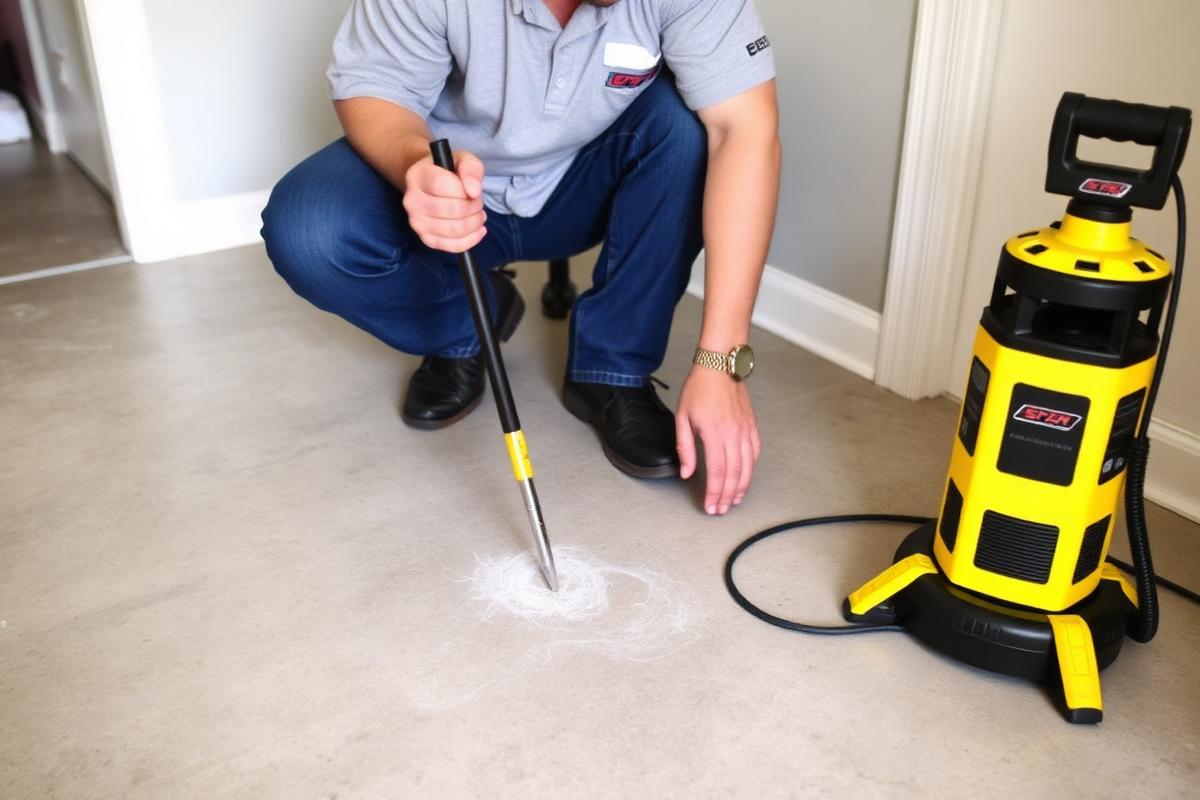
The Sound of a Leak
The characteristic signature is a steady hiss or rush, distinct from the intermittent sounds a building makes. Its pitch and volume depend on line pressure, the size and shape of the opening, the pipe material, and what surrounds the pipe.
Higher frequencies attenuate fastest, so the sound heard at the surface above a slab leak is duller than the sound at the pipe. That is useful: as a technician moves a ground microphone across a grid, the point where high-frequency content peaks is generally closest to the escape.
How It Is Done
- 1
Quiet the site
Pumps, ice makers, air handlers and irrigation are shut down so the only continuous sound in the system is the leak.
- 2
Listen at contact points
Valves, hose bibbs and meter fittings couple directly to the pipe and confirm that leak noise is present in that system at all.
- 3
Grid the surface
Ground microphone readings are taken in an ordered pattern rather than at random, and compared for intensity.
- 4
Narrow to a peak
The grid is tightened around the loudest area until the reading peaks in a small, repeatable spot.
Conditions That Make It Hard
- Traffic, machinery and pool equipment producing continuous ambient noise
- Loose sandy fill that absorbs sound before it reaches the surface
- Thick or heavily reinforced concrete
- Very low system pressure, or a leak so small it barely turbulates
- Soil already saturated by rain, which changes how sound transmits
Interpretation Is the Skill
Equipment reports amplitude; it does not report meaning. Sound reflects, travels along pipe past the leak, and pools in voids. Knowing how a building is plumbed and how sound behaves in it is what separates a mark that is right from one that is merely loud.
Not sure where the water is coming from?
Describe what you are seeing and we can explain how the investigation would be approached on your property.
Frequently Asked Questions
- What is acoustic leak detection?
- It is the practice of locating a leak by listening for the turbulent noise pressurized water makes as it escapes, using amplified microphones and contact probes to find where that sound is strongest.
- Does it work on drain lines?
- Not usually. Drains are not pressurized, so they produce no continuous noise. They are investigated with fill-and-hold testing and camera inspection instead.
Related Pages
This method is one part of professional leak detection in Tampa.