Pool Leak Detection in Tampa, FL
Pool water loss has three broad sources — the shell, the plumbing, and the equipment pad — and the first job is deciding whether there is a leak at all.
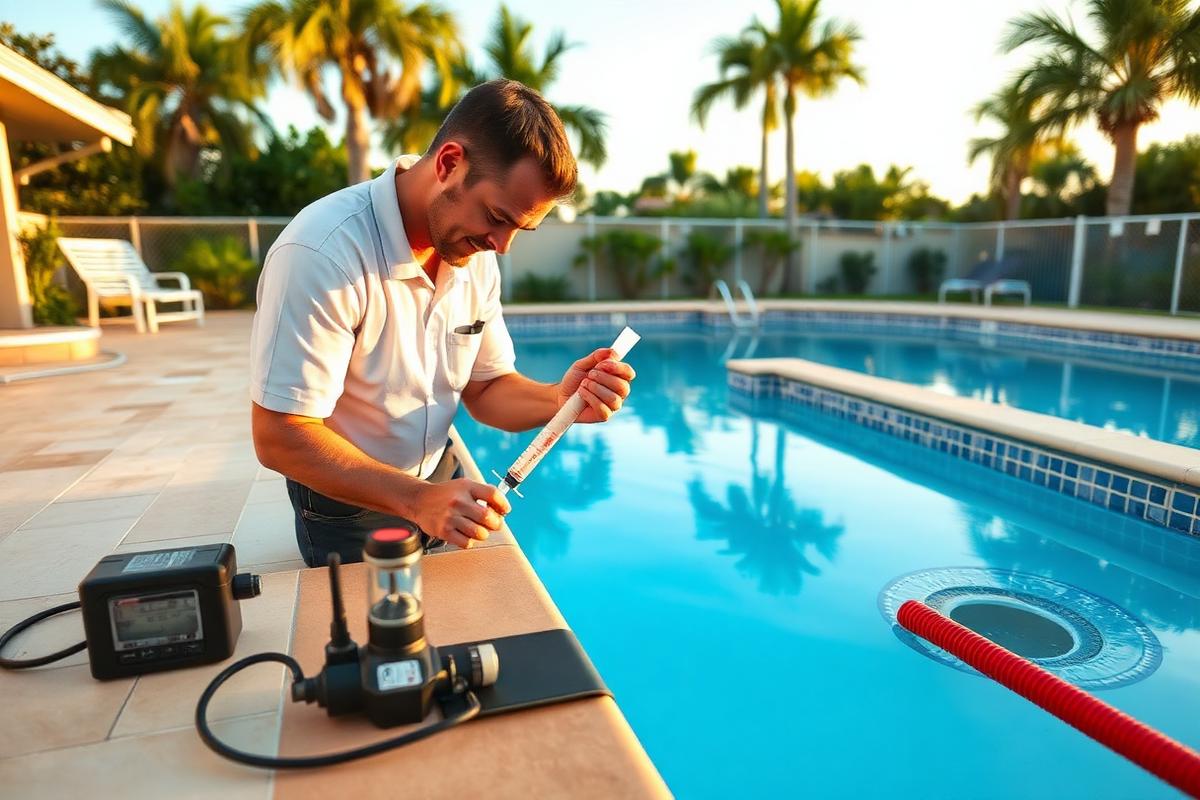
Evaporation or a Leak?
Florida pools lose water to evaporation every day, and the rate rises with heat, wind, low humidity, water features and heater use. A screened, shaded pool behaves differently from an open, sun-exposed one, which is why a single measurement is not conclusive.
The comparison test is the useful tool: a container of pool water set on a step so that both levels start equal, then measured after a fixed interval. Both levels dropping equally suggests evaporation. The pool dropping faster suggests a leak, and gives a rough magnitude to work with.
Narrowing Down the Source
- Loss that continues with the pump off points more toward the shell or a static-side issue
- Loss that increases when the pump runs points toward pressure-side plumbing or return lines
- Wet or eroded ground near the equipment pad points at pad plumbing, valves or the filter itself
- A dropping level that stops at the skimmer or light niche narrows the elevation of the leak
- Air in the system or a pump that loses prime suggests a suction-side issue
Where Pool Leaks Actually Occur
Skimmer throats and the joint where the skimmer meets the shell, light niches and conduit, return and main drain fittings, tile line cracks, structural cracks in the shell, and the buried plumbing that connects all of it to the pad. On the pad itself, unions, valve bodies, pump seals, filter clamps and heater connections all seep.
Screen enclosures and pavers complicate visual inspection, because a plumbing leak under a deck often shows up as a settled paver rather than standing water.
Why It Is Worth Resolving
Beyond the water and chemical cost, continuous loss under a deck erodes fill and can undercut pavers, coping and the deck slab. A leak that is located while it is still a plumbing problem is a much smaller project than one addressed after the deck has moved.
Why Pool Leaks Are Hard to Locate
A pool combines a large water-holding structure with buried pressurized and suction plumbing, several separate line runs, and a deck or enclosure covering most of it. Water escaping anywhere in that system disappears into sandy fill without surfacing, and evaporation constantly muddies the measurement. Suction-side leaks can even draw air in rather than push water out, so they show up as a pump losing prime instead of a wet spot.
What a Pool Leak Inspection Involves
- 1
Establish the loss
The auto-fill is disabled and a bucket comparison confirms the pool is losing more than the weather explains, and roughly how much.
- 2
Compare pump on and pump off
How the rate changes between states separates static shell and suction-side issues from pressure-side plumbing.
- 3
Inspect the pad and shell
Unions, valve bodies, pump seals, filter clamps and heater connections, then the tile line, skimmer throats, light niches and fittings.
- 4
Test the plumbing lines
Individual lines — skimmer, returns, main drain, spa, water features — isolated and pressure tested to see which will not hold.
- 5
Locate the point
Listening and locating equipment along the failing line until an indication can be confirmed and marked on the deck or ground.
What You Should Receive
- Whether the loss is in the shell, a specific plumbing line, or at the equipment pad
- Which line failed testing, and the marked location where it appears to be leaking
- Photographs and written findings you can hand to a pool contractor or plumber
- What was tested and ruled out, so nothing is re-investigated at your expense
- What the repair would likely involve — a pad fitting, a deck opening or a line reroute
After the Leak Is Located
Repair is a separate scope carried out by a pool contractor or plumber, depending on whether the problem is at the pad, in the shell, or in buried plumbing under a deck. Once it is done, re-running the bucket comparison is the simplest way to confirm the loss has actually stopped.
Not sure where the water is coming from?
Describe what you are seeing and we can explain how the investigation would be approached on your property.
Frequently Asked Questions
- How can I tell if my pool has a leak?
- Run a bucket comparison test over a fixed interval. If the pool level drops noticeably faster than the reference container, the loss is more than evaporation and is worth investigating.
- Is losing an inch a week normal?
- It depends on weather, sun exposure, wind and whether you run water features or a heater. Rather than relying on a rule of thumb, compare your pool against a reference container under the same conditions.
Related Pages
For the wider picture, see our overview of leak detection services in Tampa.