Thermal Imaging Leak Detection
A thermal camera does not see water. It sees surface temperature — and wet material holds and moves heat differently than dry material, which is what makes a leak visible as a pattern.
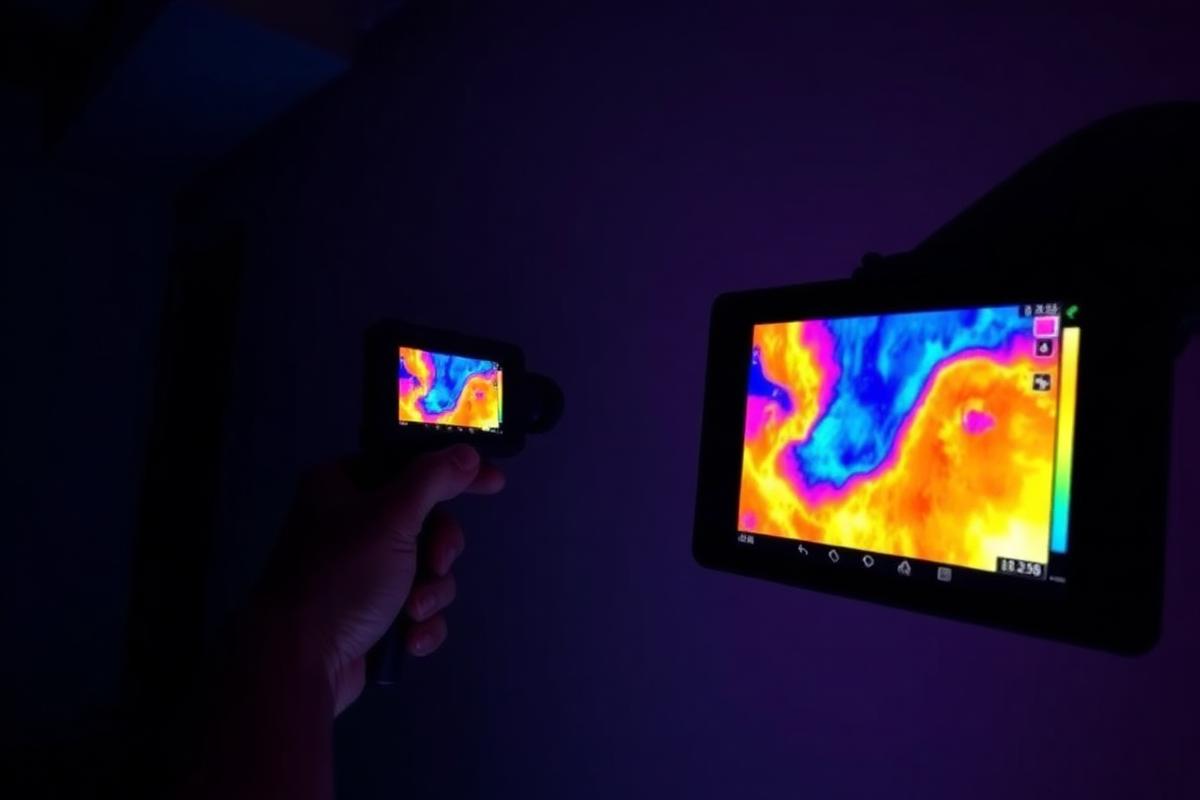
What the Camera Is Actually Showing
Every surface emits infrared radiation according to its temperature. A thermal camera renders those differences as an image. Where water has soaked into drywall, plaster, tile bed or concrete, the material's thermal mass and evaporative cooling change the surface temperature enough to appear as a distinct shape.
Hot-water leaks are the clearest case: escaping hot water warms the surrounding material and produces a bright, often plume-shaped pattern. Cold-water leaks show up in reverse, as a cooler area created by evaporation.
Where It Helps Most
- Mapping the extent of moisture behind a wall or above a ceiling
- Following a hot-water slab line and spotting an anomaly along its route
- Choosing where to place a moisture probe or make access
- Documenting the wet area before and after drying
Why It Is Never Used Alone
Many things look like moisture on a thermal image: a stud behind drywall, insulation gaps, a duct run, direct sun on an exterior wall, a recently used appliance. In Florida's humidity and heat, false patterns are common enough that a thermal indication is a place to check rather than a conclusion.
Every thermal finding is verified — with a moisture meter, with acoustic listening, or with pressure isolation — before it becomes a marked location.
Conditions That Improve Results
A reasonable temperature difference between the water and the building materials helps, as does avoiding surfaces in direct sun. Scanning an interior wall early in the day, or after conditioning the space, tends to produce cleaner readings than scanning a sun-baked exterior at midday.
Not sure where the water is coming from?
Describe what you are seeing and we can explain how the investigation would be approached on your property.
Frequently Asked Questions
- Can thermal imaging find water leaks?
- It can reveal where moisture has accumulated behind a surface and help narrow the search, but it detects temperature patterns rather than water itself and should always be confirmed by another method.
- Is infrared the same as thermal imaging?
- In this context, yes — infrared cameras are thermal imagers. The terms are used interchangeably in leak work.
Related Pages
This method is one part of professional leak detection in Tampa.